
Part one of a series on building arguments with AI. The method: Build → Arrange → Improve → Personalize.
Why Argue?
Arguments feel complex, but they all start from the same simple desire: you want to defend a claim. Knowing what you want to say, and why you want to say it, is key. AI can make that easier or much harder. Same tool, two modes: a helpful thinking partner, or a machine that submerges your thoughts. What separates them isn't how much you use it. It's what you hand over.
Delegate Your Thinking, Don’t Offload It
One of the biggest challenges of working with AI is the threat of the algorithm doing the thinking for you. Threading the needle between augmented thinking and surrendered thinking is challenging but doable.
In 2024, Matthias Stadler, Maria Bannert, and Michael Sailer studied the co-reasoning of students with AI. They asked 91 university students to think through a real problem — the safety of nanoparticles in sunscreen — and to produce recommendations on what to do. Half worked with ChatGPT, half with a traditional search engine. The ChatGPT group reported significantly lower cognitive load across every dimension measured. Their outcomes were also much worse than the control group’s. Their justifications were simply weaker, the product of shoddy reasoning.
But the same research group ran a follow-up — still a preprint, so treat it as preliminary — that added one variable: domain expertise. This time, medical students and social science students both researched the same nanoparticle question. For the students with relevant domain knowledge, the effect inverted: working with the chatbot improved the quality of their reasoning. Knowledge gave them a framework to think with and standards to check the machine against.
A similar pattern shows up outside the lab. When Microsoft Research and Carnegie Mellon surveyed 319 knowledge workers about their AI use, two findings emerged in mirror image. The more people trusted the AI's competence, the less critically they examined its output. But the more confident they were in their own competence at the task, the more critically they engaged. Confidence itself isn't the variable. What matters is whose competence you trust: the machine's, or yours.
This need to examine the output holds at the level of the task, too. In a Harvard-led field experiment, 758 consultants at Boston Consulting Group worked through realistic assignments with GPT-4. On production tasks — generating ideas, drafting copy, writing persuasive memos — AI lifted the quality of their work by roughly 40%. But on a task that demanded judgment against messy evidence, where the AI's confident recommendation happened to be wrong, consultants using AI performed worse than colleagues working unaided. Producing was safe to share. Judging was not.
So what should you take away from this research? Three things.
First, the benefit of AI is not evenly distributed. It goes to the people who bring knowledge to the exchange.
Second, knowledge only protects you if you trust it enough to use it. That is the lesson of the 319 knowledge workers. Those who deferred to the machine’s competence stopped checking its work. Those who trusted their own competence kept checking.
Third, and perhaps most importantly, don’t hand off the evaluation of the reasoning. You are so much better at it, and risk real harm both to your critical thinking and to the quality of your work when you do.
In short: bring what you know, trust what you know, and embrace your role as the decider. Let’s now put that into action with the first step of developing an argument.
Build
There are three principles that should guide how you use AI to craft the content of your argument.
The claim, never delegated.
The first principle is always to decide what you want to argue. Often you already know. You’re reacting to something you heard, or you have something you need to communicate. That’s your claim, and it can usually be reduced to a sentence or two.
Sometimes you don’t know what you think, and the temptation to have the machine magic one up is real. Resist it. Identifying the claim is the cornerstone of evaluating everything that follows: you need to know what you think, why it matters, and what’s at stake for the people you’re addressing. Without that, you have no standard to judge anything against.
Outsource this piece and you are running the Stadler experiment on yourself, in reverse. The work will feel easier. The reasoning underneath will be thinner. And the position you end up defending will be one that nobody, strictly speaking, holds.
The evidence, yours first.
Now that you know what you want to argue, you’ll need evidence and justifications to support it. Begin with what you know. Write down the evidence you have for your claim before engaging with AI. It can be incomplete, half-remembered, even a bit cryptic, but it should all share one essential quality: it’s yours.
This braindump does two jobs. The first is to ground your confidence. The research says that confidence in your own competence is what keeps you critically engaged, but that confidence has to rest on something. Once the dialogue unfurls, you need to know why you believe your claim in the first place, and the braindump is your record of that. The second job is subtler. The list draws a line, in advance, between what you know and what the machine tells you. Everything on the page before your first prompt is yours. Everything that arrives after is imported.
Discovery, hand it over.
Now we’re ready to take advantage of the real superpower of LLMs: they have access to more information than you. The job at this stage is to build out the evidence for your claim. Check the provenance of what you already have. Find what’s adjacent. Ask for the strongest justifications available, the data you didn’t know existed, the sources that support you better than the ones you brought. Delegate this fully.
Your job resumes when the results come back, because discovery returns more material than any argument can hold. That’s selection, and selection is judgment. Yours. Here are things to keep in mind as you sort through the material:
Does this bear directly on my claim, or is it just interesting?
Would it move a fair-minded skeptic?
Can I vouch for it?
If the answer to any of these is no, don’t include it. Slow work, but it’s your work.
Here's the division of labor for the build phase:
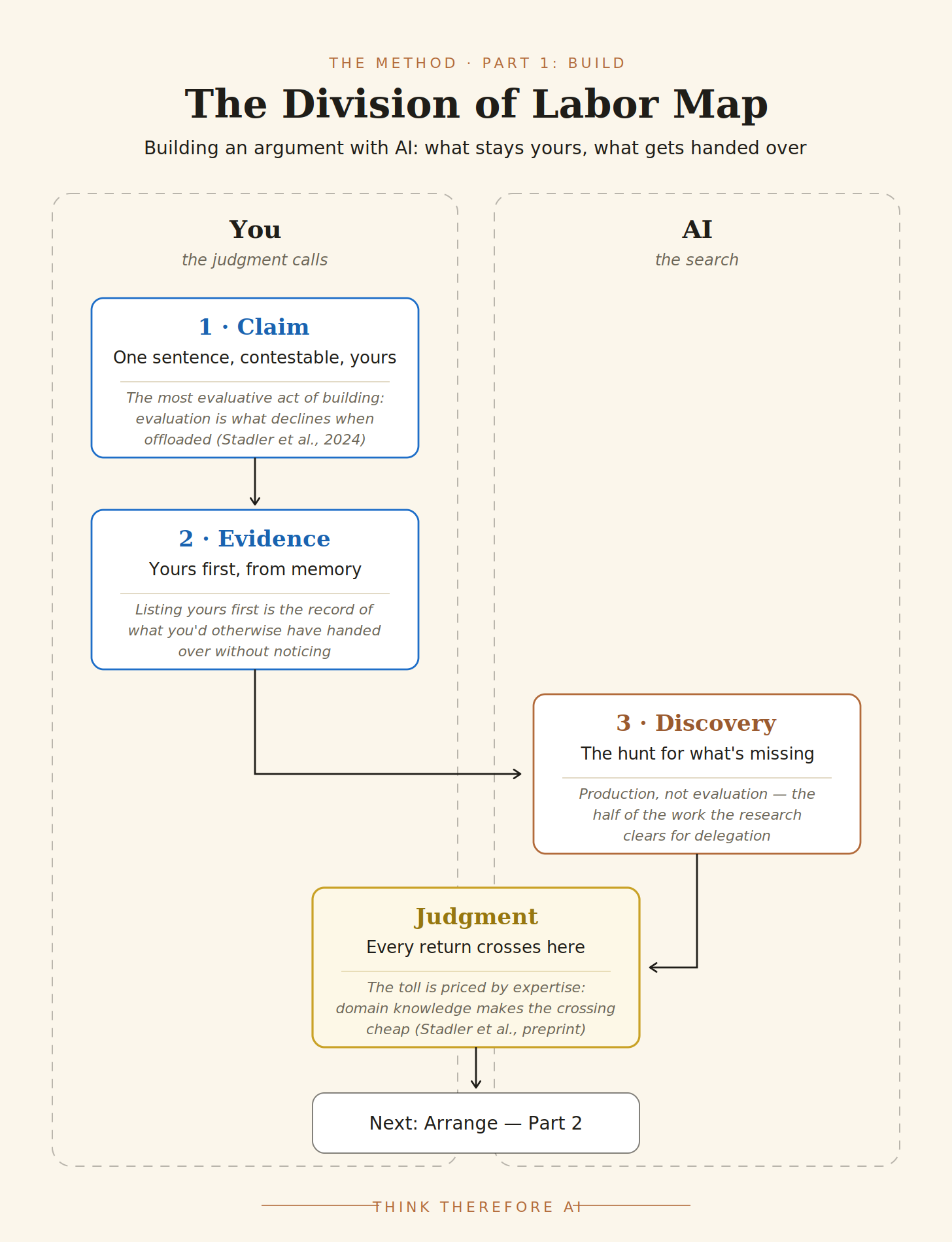
None of this makes the work effortless. It moves the effort to the parts that matter.
Try This
If you're having trouble deciding whether your claim is what you want to say, write down its opposite. If the opposite is dead obvious, or so empty that nobody would bother attacking it, you aren't there yet. Your original is a platitude, not the cornerstone of a strong argument. You can make this test even sharper by thinking of an actual person who'd take the rival side. What would they say? Having something concrete to push back against can make identifying the claim easier, and their counterargument is something you can use later.
Next up — Arrange: assembling the parts so that others can easily understand how your claim and support fit together.
Great approach. I also find myself debating Claude on some of my most interesting ideas. It disagrees with me on some issues. I am better than it at crafting good arguments, I think in part because I propose good thought experiments, it almost never does. Instead it runs to cite prior research. But I think the debate may be good practice.
You had me at "Knowing what you want to say, and why you want to say it, is key."